
Beyond the Prototype: What Makes a Portable qPCR Instrument Ready for Production?
A successful qPCR run is an important milestone in instrument development. It shows that the optics, thermal system, electronics, and software can work together under a particular set of conditions.
But one successful run doesn't mean an instrument is ready for production.
For a qPCR manufacturer, the challenge is making sure that the next instrument performs as expected, and the one after that does too.
This distinction matters to companies developing commercial molecular testing products. Whether an instrument will be used in a laboratory, supplied alongside a manufacturer's PCR assays, or deployed across multiple testing sites, customers need more than a working prototype. They need equipment that can be manufactured consistently, tested systematically, and supported over time.
At Anitoa, the development of our Maverick qPCR platform has involved not only designing compact instruments, but also establishing the manufacturing and testing processes needed for repeatable production.
1. A Working Prototype Is Only the Beginning
Instrument development often starts with proving that a technical concept works.
For portable qPCR, that may involve demonstrating fluorescence detection, achieving the required heating and cooling performance, and producing usable amplification curves.
At the prototype stage, engineers can spend considerable time adjusting individual components and fine-tuning system behavior. That is a normal part of development.
Production presents a different challenge.
An instrument must be assembled from components with normal manufacturing variations. Different operators may work on different units, and parts may come from different production batches. Yet the finished instruments still need to meet the same defined performance requirements.
This is where a promising design must become a repeatable manufacturing process.
For a commercial instrument, it is not enough to demonstrate that the design can achieve a particular performance level. The manufacturer also needs practical procedures for reproducing and verifying that performance across production units.
2. Consistency Starts with Optical and Thermal Assembly
Fluorescence detection and temperature control are two of the most important systems in a real-time PCR instrument.
Small variations in optical alignment, excitation intensity, or signal acquisition can influence fluorescence measurements. Similarly, differences in thermal performance can affect the conditions under which PCR amplification takes place.
Anitoa's Maverick platform uses a fixed optical architecture built around our proprietary ultra-low-light CMOS sensing technology.
The absence of moving optical scanning components reduces mechanical complexity. However, a fixed optical system still requires careful assembly and testing.
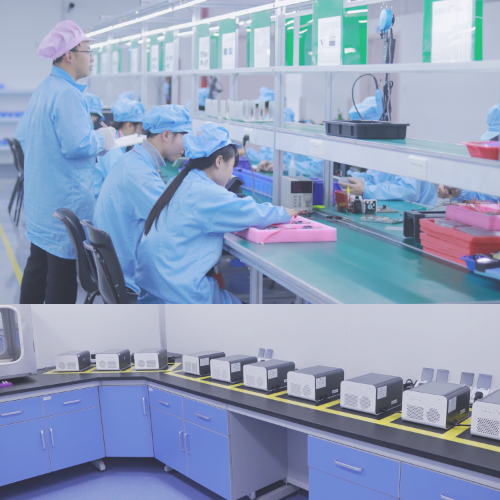
At Anitoa's production facility, optical assembly and optical testing are organized as separate operations.
During optical testing, an illuminance meter is used to measure the light-source intensity of individual channels. The testing process also uses dyes for different fluorescence channels, together with a white-light source, to evaluate consistency across sample wells.
These checks address practical aspects of optical performance that cannot be established from the sensor specification alone.
The thermal system has its own assembly and testing stages.
Production testing covers heating and cooling rates, spatial temperature uniformity, and temperature indication error. Together, these measurements provide a broader view of thermal performance than ramp speed alone.
A system may heat quickly, but it must also reach and maintain the intended temperatures with appropriate accuracy and consistency.
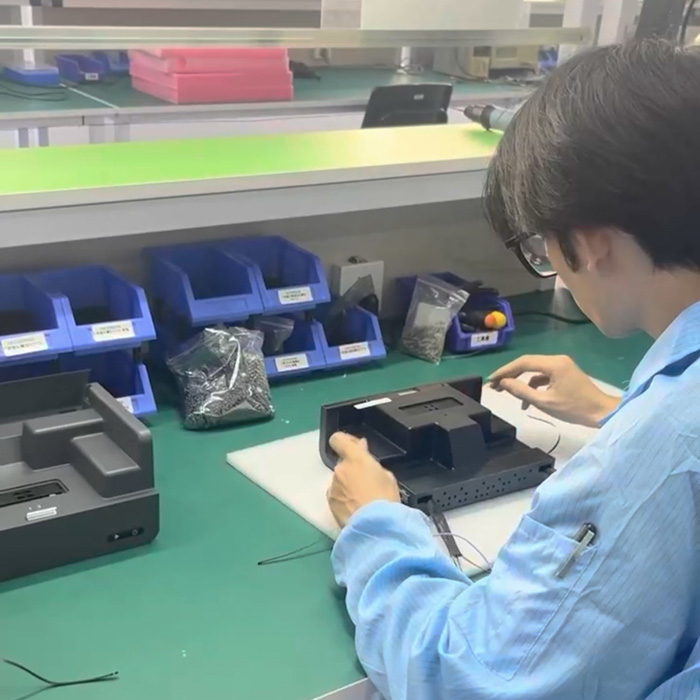
Following subsystem assembly and testing, components proceed through further assembly stages before integration into the complete instrument.
This separation of operations gives production teams opportunities to identify issues before the instrument reaches final testing. It also makes it easier to investigate whether a problem is associated with a particular subsystem or with the final integration.
3. Every Instrument Goes Through Final Testing
Once the optical, thermal, electronic, and mechanical components are integrated, the instrument needs to be evaluated as a complete system.
A component can meet its individual requirements and still behave differently after installation in a finished instrument.
That is why final testing needs to go beyond confirming that the device powers on.
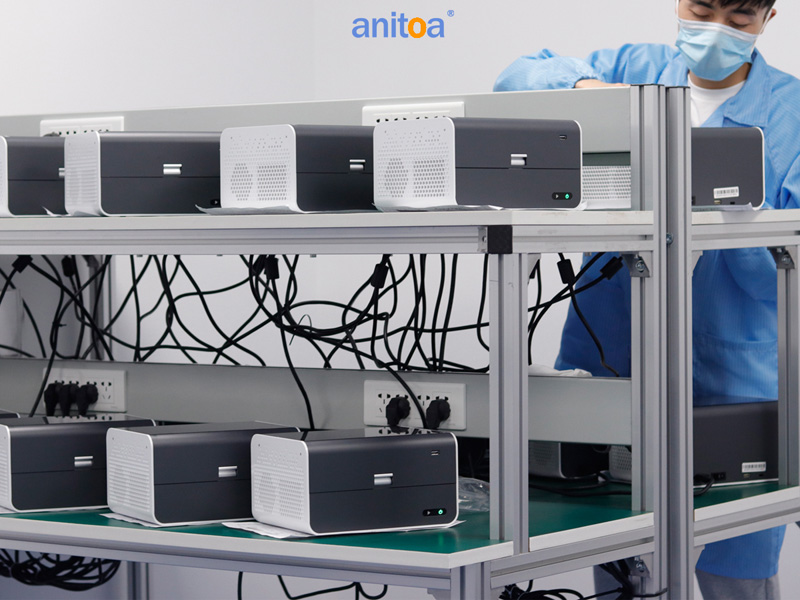
At Anitoa, every completed instrument undergoes final testing.
The testing program includes run-time checks and the evaluation of four performance characteristics: repeatability, linearity, sensitivity, and channel crosstalk.
Each addresses a different aspect of instrument behavior.
Repeatability concerns the consistency of measurements under specified conditions. Linearity evaluates how the measured response relates to changes in signal level. Sensitivity concerns the instrument's ability to detect weak signals under defined test conditions, while crosstalk testing evaluates unwanted signal interference between fluorescence channels.
Run-time information is also reviewed across production batches as part of performance monitoring.
Test records are uploaded to Anitoa's internal production-records cloud system and are also organized into Excel files for archiving by production batch.
This gives the production team a documented record of instrument testing and a practical way to review results across different units and batches.
The company also maintains a dedicated area for investigating issues identified during manufacturing and testing. When an abnormal result appears, identifying whether it is related to the optics, thermal control, electronics, or instrument integration is an important part of resolving the problem.
It is also worth distinguishing instrument testing from assay validation and compatibility evaluation.
An instrument that passes its production tests has met the applicable instrument-level acceptance requirements. This does not mean that every PCR assay will automatically achieve its intended analytical performance on that instrument.
Assay-specific performance still depends on the reagents, sample preparation, thermal protocol, fluorescence chemistry, and validation process.
For assay developers and OEM partners, understanding this distinction is essential when planning instrument integration projects.
4. Designing for Everyday Use, Not Just Laboratory Demonstrations
A compact qPCR instrument may eventually operate in settings quite different from the engineering laboratory where it was developed.
Some customers use their systems in established testing laboratories. Others need equipment for veterinary testing, aquaculture, agricultural applications, mobile laboratories, or other decentralized testing workflows.
Each environment places different demands on the instrument.
Equipment may need to be transported between locations, operated by different users, or used for small numbers of samples throughout the day.
In these situations, reliability is not limited to analytical specifications.
The physical design, user interface, consumable compatibility, maintenance requirements, and serviceability all influence how well an instrument fits into daily work.
An instrument that is difficult to assemble or maintain may create unnecessary problems after delivery, even if it performs well during laboratory demonstrations.
These practical considerations have influenced the continued development of Anitoa's Maverick qPCR platform.
The current MQ4 series builds on years of engineering, production experience, and customer applications.
Rather than developing a completely new instrument for every project, we generally begin with established MQ4 configurations and evaluate whether additional adaptation is needed.
This provides a more predictable starting point while preserving flexibility for different testing requirements.
5. What OEM and Assay Partners Should Look Beyond
For an assay developer or instrument brand, choosing a qPCR supplier involves questions that may not appear on a product specification sheet.
Can the manufacturer continue supplying the same instrument configuration as demand grows? How are optical and thermal performance checked during production? Does every finished instrument undergo testing, and are the results recorded for internal review?
What happens when a component needs to be replaced or a production issue requires investigation? Can the supplier provide engineering support when an assay requires a different thermal protocol, fluorescence configuration, or software workflow?
These questions become particularly important when a company intends to sell an instrument-and-reagent solution under its own brand.
An initial evaluation may involve only a few instruments. Commercial deployment, however, depends on consistent manufacturing, reliable supply, and continued technical support.
At Anitoa, dedicated optical and thermal testing, final instrument inspection, and production test records are part of our manufacturing workflow.
Our manufacturing activities are also supported by an ISO 13485-certified quality management system.
For partners, these arrangements provide a clearer picture of how the instrument is produced and evaluated beyond the initial demonstration. They also provide a practical foundation for discussing longer-term OEM/ODM cooperation.
6. Building on a Platform That Has Already Reached Production
The Maverick qPCR platform has evolved through multiple instrument generations and years of manufacturing and customer use.
Today, the Maverick MQ4 series is our main platform for standard instrument supply and OEM/ODM cooperation.
The series includes four-well and sixteen-well configurations, with fluorescence-channel options for different assay requirements.
For many customers, the value of an established platform is not simply avoiding the cost of developing a new instrument. It means starting with a product that has already gone through engineering refinement, manufacturing, testing, and real-world deployment.
This does not mean every new assay will work without further evaluation. Fluorescence dyes, reaction volumes, consumables, thermal protocols, and result interpretation still need to be reviewed for each project.
What an established platform offers is a more practical foundation for that work.
Anitoa continues to refine the Maverick platform through engineering development, production experience, and customer feedback.
A successful prototype proves that an instrument can work. Repeatable manufacturing, systematic testing, and documented production records help turn that design into a product customers can depend on.
Working with Anitoa
Anitoa develops and manufactures compact real-time PCR instruments for assay developers, reagent manufacturers, testing organizations, and OEM/ODM partners.
If you are evaluating a qPCR instrument platform for an existing assay or planning an instrument-and-reagent product, we welcome discussions about configuration, compatibility, manufacturing, and project requirements.
Explore the Maverick MQ4 platform or contact our team to discuss your project.