
How to Match a PCR Assay to a qPCR Instrument: 6 Things to Check First
By Anitoa Technical Team | Published: September 1, 2026
For companies with an established PCR assay, choosing a qPCR instrument may seem straightforward: confirm the fluorescence channels, enter the thermal protocol, and run the test.
In practice, assay compatibility involves more than successful amplification.
A useful evaluation should confirm that the assay, instrument settings, fluorescence detection, software and result interpretation work together as a complete workflow.
Before testing a new instrument, these six items are worth checking first.
1. Fluorescence Dyes and Detection Channels
Start with the actual dyes used in the assay and the number of targets that need to be detected simultaneously.
Two instruments described as “four-channel qPCR systems” may not have exactly the same excitation and detection ranges. It is therefore more useful to provide the specific dyes—such as FAM, HEX/VIC, ROX or Cy5—than simply state the number of channels required.
For multiplex assays, channel separation and the performance of the complete dye combination should also be evaluated under actual test conditions.
2. PCR Thermal Protocol
The existing PCR protocol is one of the most important inputs for instrument evaluation.
Useful information includes:
-
Reverse transcription or initial denaturation conditions
-
Denaturation and annealing/extension temperatures
-
Hold times
-
Number of cycles
-
Whether melting curve analysis is required
Different instruments use different thermal architectures and control strategies. A published maximum heating rate therefore does not tell you how long a complete assay will actually take.
A more practical approach is to run the full assay protocol on the target instrument and evaluate both total run time and amplification performance.
3. Reaction Volume and Consumables
The assay format also needs to match the instrument.
This includes reaction volume, tube or strip format, cap type and any consumable requirements that may affect thermal transfer or optical detection.
For an assay that is already commercialized, keeping the existing reaction format is often preferable. Changing the instrument, consumable and reaction system at the same time can create unnecessary validation work.
Confirming consumable compatibility early helps avoid this.
4. Actual Throughput per Run
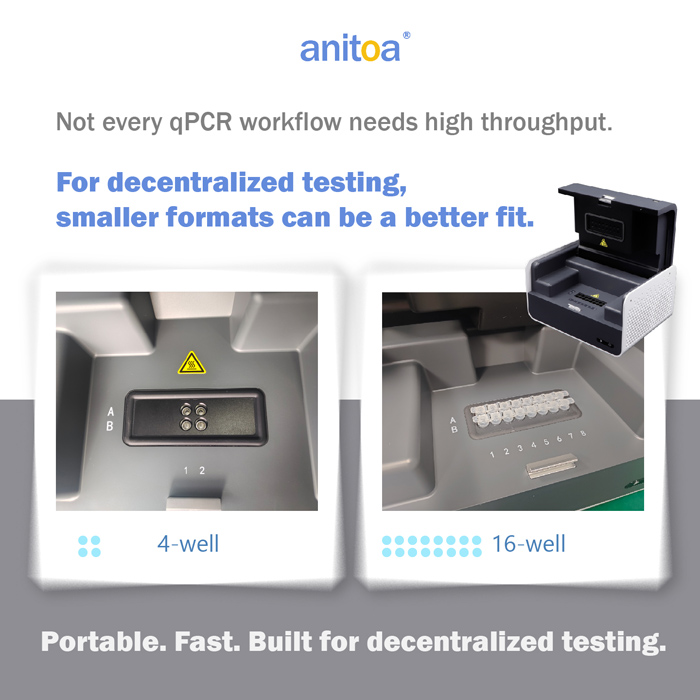
Instrument capacity should be calculated from the complete test setup, not just the number of unknown samples.
For example, if a field test includes:
-
2 unknown samples
-
1 positive control
-
1 negative control
A four-well instrument may be sufficient for the entire run.
If a routine batch contains around 10–12 samples plus controls, a 16-well system may be more appropriate.
The exact calculation depends on the assay. Internal controls, replicates, standards or additional quality controls may require separate reaction wells.
5. How Will the Data Be Interpreted?
A good amplification curve is not the final product. The customer ultimately needs a usable result.
Before instrument evaluation, it helps to define:
-
Whether Ct or Cq is used
-
How thresholds are set
-
Whether a standard curve is required
-
Whether quantitative analysis is needed
-
Whether melting curve analysis is involved
-
How positive, negative or other results are determined
-
What reports or data formats are required
For some assays, differences in software processing can affect the final interpretation even when the raw fluorescence data are similar.
This is why assay compatibility should not stop at the hardware level. Software and data processing are part of the evaluation as well.
6. Intended Use and Target Market
The same PCR assay may require very different instruments depending on where and how it will be used.
A central laboratory may prioritize throughput and automation. A decentralized testing site may care more about instrument size, run time, power requirements and data connectivity.
The target market should also be considered early.
Labels, manuals, technical documentation and regulatory requirements can differ by country, product configuration and intended use. If the final product will be marketed as an integrated assay-and-instrument solution, these requirements are easier to address when they are identified during instrument selection rather than after development is complete.
Assay Compatibility Is Really About the Complete Workflow
In practice, matching an assay to a qPCR instrument comes down to three questions:
Can the instrument run the assay?
Can it generate stable and repeatable data?
Can that data be processed into the result the assay requires?
The first two are mainly about instrument and experimental conditions. The third brings software, algorithms and result interpretation into the picture.
When evaluating projects on the Maverick qPCR platform, Anitoa therefore looks at the fluorescence channels, PCR protocol, consumables, instrument configuration and data requirements together rather than treating compatibility as a simple “run the reagent on another machine” test.
For customers with established assays, this approach can identify potential mismatches earlier and reduce unnecessary changes later in OEM/ODM or product development.
What Should You Prepare for an Initial Evaluation?
A first evaluation usually does not require a large technical package.
The following information is normally enough to begin:
-
PCR assay or target
-
Fluorescence dyes and required channels
-
Thermal protocol
-
Reaction volume and consumable format
-
Samples and controls per run
-
Result interpretation requirements
-
Intended application
-
Target market
For companies with an established PCR assay, the goal is not simply to find the instrument with the longest specification list.
It is to find a qPCR platform that can reliably support the assay, its data and the final testing workflow.
Evaluating a PCR Assay on a qPCR Platform?
If you already have a PCR assay or defined testing workflow, you can share the assay format, fluorescence channels, thermal protocol, expected throughput and result requirements with Anitoa.
We can begin with an initial evaluation based on the Maverick qPCR MQ4 platform.
Explore Maverick qPCR MQ4 →
Submit a Project Inquiry →