
Portable qPCR for Field & Decentralized Molecular Testing | Anitoa
By Anitoa Technical Team | Published: August 24, 2026
Real-time PCR is already a mature molecular testing method. In high-throughput laboratories with stable workflows, conventional benchtop qPCR systems remain an efficient choice.
But not every sample starts in a central laboratory. When testing needs to happen closer to a farm, field site, small laboratory, mobile unit, or other decentralized location, the decision criteria change. Portability, speed, power requirements, sample throughput and data access can matter as much as raw instrument capacity.
Portable qPCR is most useful when it changes the workflow - not simply when the instrument is smaller.
The real value is bringing molecular testing closer to the sample
A centralized workflow often looks like this: sample collection, transport, queueing, testing, then result reporting. For large batches, that model works well. For a few samples spread across multiple locations, however, transport and waiting time can become a major part of the total turnaround time.
A compact, low-throughput qPCR system can move testing closer to where the sample is collected. In the right setting, this can reduce logistics and waiting costs while giving users molecular-level information sooner.
That cost point matters. A high-throughput instrument is not automatically more economical if only a handful of samples are tested at a time. Matching instrument size and throughput to the real workload can improve overall cost efficiency.
When is portable qPCR a better fit?
1. Low sample throughput
Many field or decentralized workflows do not need 96 or more wells at once. If only a few samples are tested per run, a 4-well or 16-well format may better match the actual workload and reduce the need to wait for a larger batch.
2. Distributed testing locations
Animal health, aquaculture, agriculture, environmental monitoring and other professional testing programs may operate across many sites. Sending every sample to a distant central laboratory adds transport, sample-handling and reporting steps. Portable qPCR can support smaller testing nodes closer to the point of need.
3. Faster decisions matter
PCR cycling time is only one part of turnaround time. Transport, queueing and result transfer can take longer than the run itself. Moving the instrument closer to the sample can shorten the overall workflow, even when the assay chemistry remains unchanged.
4. Space or infrastructure is limited
Some testing locations have limited bench space, intermittent access to laboratory infrastructure, or a need for mobile deployment. Compact instruments are easier to place in these environments. External battery power, mobile-network connectivity and cloud-based data management can extend that flexibility further.
Cost can change which testing method is practical
In suitable workflows, a small qPCR system can lower the practical cost of molecular testing by reducing unnecessary instrument capacity, sample transport and waiting time. This can make molecular testing feasible in locations where it previously felt too expensive or operationally difficult.
Where an assay has been properly validated, qPCR may also provide more sensitive or specific information than some conventional rapid screening approaches. That does not mean every traditional method should be replaced. It means that, when the economics and workflow make sense, molecular testing can move earlier in the decision process instead of being reserved only for later confirmation in a central lab.
The result can be earlier identification of a problem and faster follow-up - especially in applications where delays have real operational consequences.
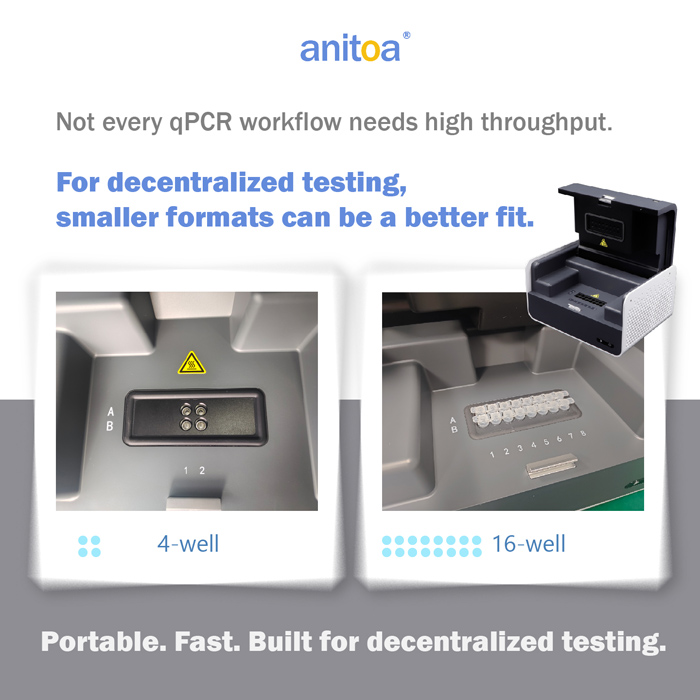
4 wells and 16 wells support different workflows
For portable qPCR, higher throughput is not always better. The right configuration depends on how many samples are actually tested at one time.
A 4-well configuration is well suited to focused field tasks, very small sample batches and deployments where instrument size, power use and mobility matter most. A 16-well configuration offers more capacity while remaining compact, making it better suited to low-throughput professional testing, assay development and routine small-batch work.
A useful first question is therefore not "How many wells can the instrument hold?" but "How many samples do we normally need to test at one time?"
What happens to the data after field testing?
Decentralized instruments create a second challenge: decentralized data. If every result stays on the local instrument, managing multiple testing sites quickly becomes difficult.
Network connectivity and cloud-based data management can connect distributed instruments with centralized oversight. A test can be run in the field while data are uploaded for remote review, organization and further analysis. This is where portable qPCR begins to function as part of a connected testing system rather than as a standalone box.
When should you still choose a conventional high-throughput qPCR system?
If a laboratory processes large sample volumes every day and samples can be efficiently centralized, a larger automated qPCR system will usually remain the better choice. The same is true when the overall workflow depends on extensive sample preparation, automation or laboratory infrastructure that cannot be moved closer to the sample.
Portable and conventional qPCR systems are not direct replacements for each other. They solve different workflow problems.
Define the testing scenario before choosing the instrument
Before evaluating a portable qPCR platform, it helps to answer a few practical questions:
- How many samples are normally tested per run?
- Are samples concentrated in one location or distributed across multiple sites?
- How quickly is a result needed after sampling?
- Is stable power and laboratory space available?
- Do multiple sites need to use the same testing workflow?
- Does data need to be reviewed or managed remotely?
- How many fluorescence channels does the assay require?
Portable qPCR is not simply a smaller version of a laboratory instrument. Its value is in making molecular testing practical in places, volumes and workflows where a conventional system may be inefficient.
When the sample volume is modest, testing locations are distributed, or faster local decisions matter, a compact qPCR platform can improve both workflow efficiency and overall cost effectiveness - and, in some applications, make earlier molecular detection possible.
Evaluating a Portable qPCR Project?
If you already have a PCR assay or a defined testing scenario, share your expected sample throughput, fluorescence channels, PCR protocol, operating environment and target market with us.
Anitoa can begin with an initial evaluation based on the Maverick qPCR MQ4 platform.